

Guide · Construction & trades
From measurement to sign-off: the forms every trades business needs.
What belongs in each form of a job, what is often missing in practice – and how your team captures it all at the customer’s site.
In short: A job in the trades usually needs five to seven forms: measurement, quote, order, construction work report or timesheet, material record, acceptance report and finally the invoice. The invoice is only as good as the forms before it. Anything not recorded and signed on site is hard to bill later.
Why the forms belong together
Each form is the basis for the next. The measurement becomes the quote, the signed order defines the scope, and the work report and material record become the invoice. If something is missing along the way, it usually only shows up in the office – when the invoice is written. Then it’s phone calls, estimates, or hours and material that never get billed.
1. Measurement: the basis for quote and invoice
The measurement records the quantities you will bill: areas, lengths, numbers of items. What belongs in it:
- Project, address, client
- Date and who measured
- For each item: description (ideally as in the bill of quantities or quote), location (room, component), dimensions, calculation and quantity with unit
- Sketch or photo, especially for irregular areas
- For a joint measurement: signatures of both sides
Often missing: the calculation, so no one can check the quantity, and photos of work that will be covered later (pipes in walls, insulation, excavation). Measure such work before it disappears – ideally together with the customer and with a photo.
2. Quote or cost estimate
The quote defines what the customer gets and what it costs. It should include: customer, date, items with quantity and price, net, VAT, gross, validity of the quote and what is not included.
Often missing: a clear statement of exclusions (“not included: disposal, scaffolding”). That is exactly what disputes are about later.
3. Order or repair order
Before work starts, the customer should place the order in writing. For small repairs, a repair order on site is enough. What belongs in it:
- Customer with address, phone, email
- What needs to be repaired or done
- Description of the damage and photos of the condition before
- Order text: which services are ordered
- Date and customer signature
Often missing: the “before” photo. Without it, it’s hard to prove later which damage was already there.
4. Doing the work: work report and timesheet
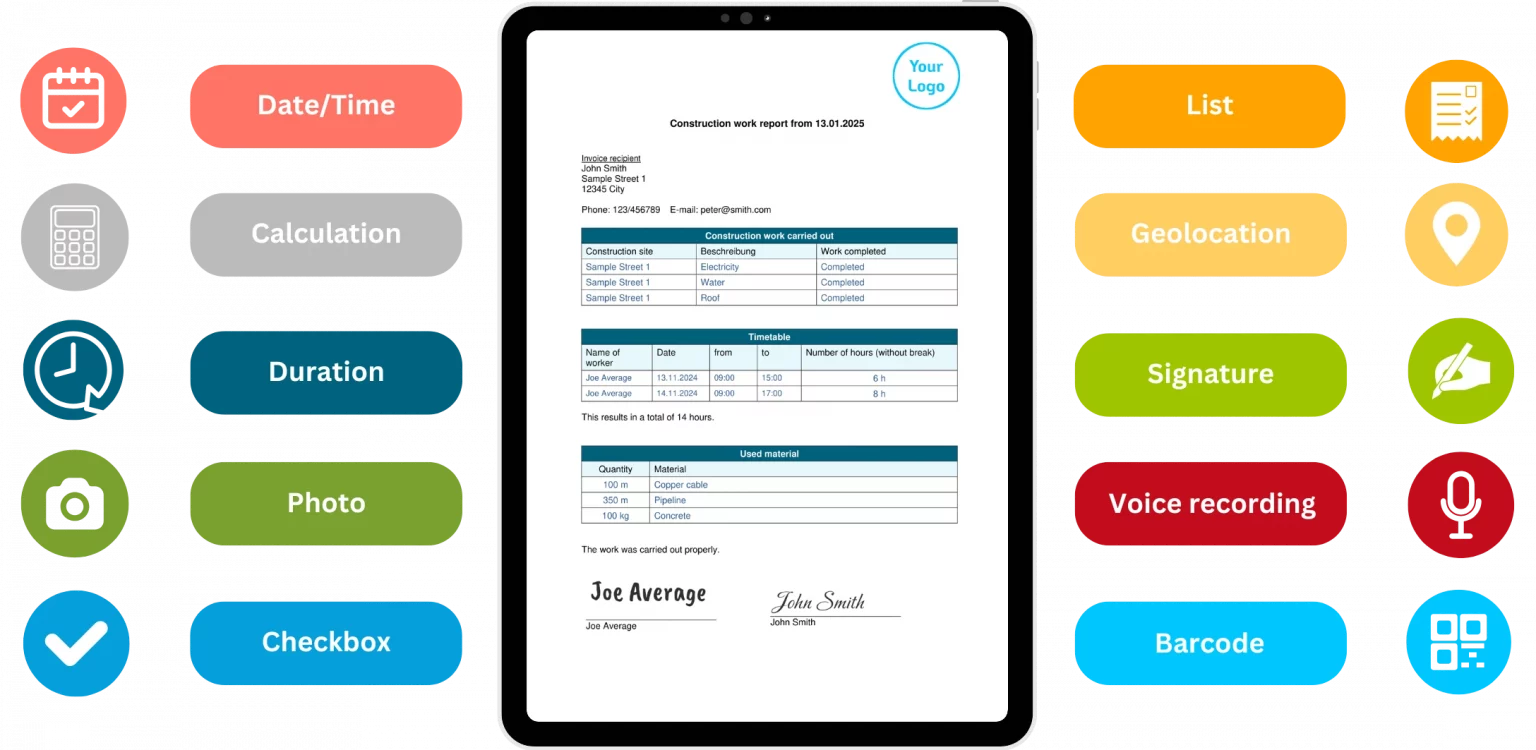
Work not in the quote but done additionally at the customer’s request belongs in the construction work report (also called daywork sheet). Your employees’ own working time goes on the timesheet. What belongs in the work report:
- Client and site
- Work carried out, even in key words
- Workers with date, start, end and hours
- Material used, with quantity
- Whether the work is completed
- Date and signatures of site manager and client
Often missing: the customer’s signature, because the sheet is only written up in the office on Friday – and the agreement that the extra work will be paid by the hour at all. What to watch out for:
- Get it ordered first. Under German VOB/B contracts, daywork is only paid if it was expressly agreed before it started. According to a ruling by the Stuttgart Higher Regional Court (January 2026), a signed work report alone does not prove this agreement. So have additional work ordered briefly in writing on site, for example with a repair order.
- Submit promptly. Under the VOB/B, daywork sheets go to the client daily or weekly, as is customary. If the client doesn’t return them within six working days, they are deemed accepted (Section 15 (3) VOB/B).
- Separate hours per task. A single total for different tasks is of little use in a dispute.
Note: This guide is not legal advice. The VOB/B only applies if it is agreed in the contract.
What belongs on the timesheet: employee, start, end and break per day, total hours, comments, date and signature.
5. Material
Material used on site belongs with its quantity in the work report or in a separate material record. Material that has to be ordered is captured with a material request: what, how much, where to deliver and by when.
Often missing: the quantity (“small parts”) – and with it, money on the invoice.
6. Acceptance
With acceptance, the customer confirms that the work has essentially been carried out as agreed. The report needs the parties, date, scope, defects with photo and deadline, reservations and both signatures. The detailed checklist is in the guide Documenting building acceptance.
7. Invoice
When measurement, work report and acceptance are complete and signed, the invoice is quick to write and easy for the customer to follow. When they’re not, the search begins.
Typical problems with paper forms
- Sheets reach the office days later, and the invoice is delayed.
- Handwriting is illegible, and quantities are retyped wrongly.
- Photos sit on private phones and can’t be matched to a job.
- The customer’s signature is missing.
- Every technician uses a different form, and something is always missing.
How it works with Formtastic
- Set up your forms: Use a template and adapt it, recreate your existing form, or create it via chat with ChatGPT or Claude.
- Fill them in at the customer’s site: on a smartphone or tablet, even without a connection. Photos, sketches and signature directly on the device; the app adds up the hours itself.
- Done in the office: The PDF in your own layout is emailed automatically to the customer and the office. The data can also flow to Excel, Google Drive/Sheets, SFTP or a webhook.
These templates are available in Formtastic:
- Measurement: your own form, e.g. built from table, photo and drawing – or we recreate your measurement sheet
- Quote: Cost estimate / offer (calculates net, VAT and gross)
- Order: Repair order
- Doing the work: Construction work report, Timesheet
- Material: Material request (with barcode scan of the item number)
- Acceptance: Building inspection, construction protocol, your own checks with the Checklist
- Invoice: Invoice
Already have your own forms? Send them to us as paper, PDF or Word forms. We’ll set up your first template for free.
Conclusion
Good forms in the trades are complete, signed by the customer and in the office right away. If you capture every step from measurement to sign-off with a fixed template, you write the invoice without follow-up questions – and never forget an hour or a piece of material again.
Read how a construction company records working hours, vehicles and repairs by app in six languages in the Gala-Tiefbau Umicevic success story.
What Dejan Ristic says
Office Manager at Gala-Tiefbau Umicevic

“Whether on a construction site or during fibre-optic installation, our multilingual teams record working hours and documentation directly on site using the app. Thanks to Formtastic’s language feature, every employee can work in their native language—saving our office a great deal of paperwork and translation stress.”


Questions about forms in the trades
Short answers to the most common questions. If there’s anything else, our team is happy to help personally.
What is the difference between a work report and a timesheet?
The work report proves additional work to the customer, with hours, material and the customer’s signature. The timesheet records an employee’s working time for payroll.
Is a signed work report enough to bill additional work?
Not always. The signature confirms hours and material. That the work is paid by the hour should be agreed beforehand, ideally in writing on site. Both together make billing safe.
Is there a template for measurements?
There is no ready-made measurement template in Formtastic. You build it in the form designer from table, photo and drawing, or send us your measurement sheet and we’ll set it up.
Does it work without internet?
Yes. The app works offline. The finished PDF is sent as soon as the device is back online.
Can my technicians fill in the forms in their own language?
Yes. Each employee chooses their language in the app. The finished PDF still reaches the office uniformly in your company language, as defined by your Word export template – including choice fields. More on Multilingual forms.
Working in trades or construction?
Construction work report, repair order, timesheet, building inspection and more templates – ready to use and easy to adapt.
Get started now
Your next job.
Paperless.
Next job, the report is done before your team is back in the car.
14 days free · No contract · Your first form set up for you